
Have you ever gone out for dinner at a lovely restaurant, looked at the menu and felt a slight twinge of anxiety because everything looks so delicious? What if you pick something that doesn’t meet your expectations? What if you get FOMO when you see what your friend has chosen?
It’s a ridiculous thought, really: it’s highly unlikely anything on the menu will be outright disgusting. Anything you choose will be tasty… just perhaps not as tasty as your friend’s selection!
This is because we have evolved to see predictability as safe and unpredictability as dangerous, leading us to prefer the familiar to the new, as first outlined in Nobel prize winning work by Tversky and Kahneman (1973). This trips us up in all sorts of ways, from clinging to people who are like us at the expense of diverse perspectives, to making bad investment decisions simply because a company is familiar (Zhu, Qi & Jin, 2023).
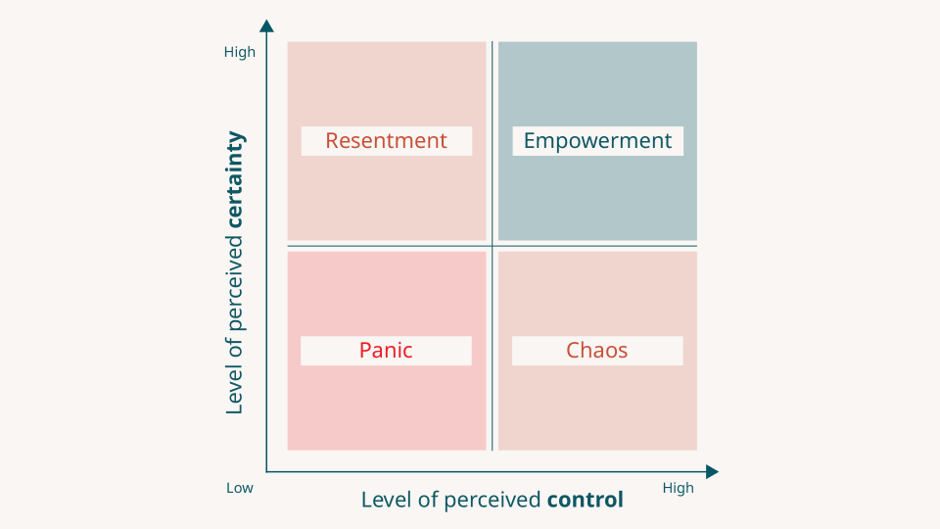
In addition to preferring the familiar, we also have a tendency to imagine an uncertain future as being more likely to be negative than positive (Anderson et al, 2019). This represents a potential loss, and another finding of the eminent Kahneman and Tversky (1979) was that we assign around twice as much weight to a potential loss as we do to an equivalent gain.
In the context of change projects, this has important implications.
Reduce uncertainty before talking about benefits
We tend to assume that the main outcome of change communications is helping people understand the benefits (the “What’s In It for Me?”). But what if it’s not the change itself that people fear – it’s the uncertainty?
We might do well to focus more on reducing uncertainty: what DO we know? What can we tell people? Can we reassure people there will not be any job cuts, or even a high-level idea of the impact? Something as simple as communicating at pre-determined times in a predictable way can help reduce the uncertainty.
I leveraged this concept in a project I worked on early in my career. It was for a well-known airline during a consultation process – a high-profile and high-risk change. The default position from leadership, HR and Legal was to say as little as possible, and there were good reasons for this: saying the wrong thing could have huge negative implications for the union negotiations, with potentially significant financial or reputational impacts. But in a vacuum, people tend to assume the worst, and any negotiation is more difficult when there is limited perceived common ground or goodwill.
I addressed these risks by creating a communications plan that:
- acknowledged the emotional toll on all concerned – speaking human to human and aiming to build trust and connection rather than distance.
- committed to regular communications at predictable time periods and formats (even if there was very little to say)
- followed through by doing it
Negativity is normal
A second implication of the research is that we should account for pessimism in how people will imagine the future state and that winning them over may require twice as much by way of potential benefits compared to these imagined losses.
This is why it’s so important to really engage with those impacted rather than relying on technical requirements documentation or business process maps alone – showing people that their opinions are heard and (more importantly) acted upon can be hugely impactful for overcoming negativity.
Change and personal identity
Another factor that’s important to consider is the personal dimension of uncertainty.
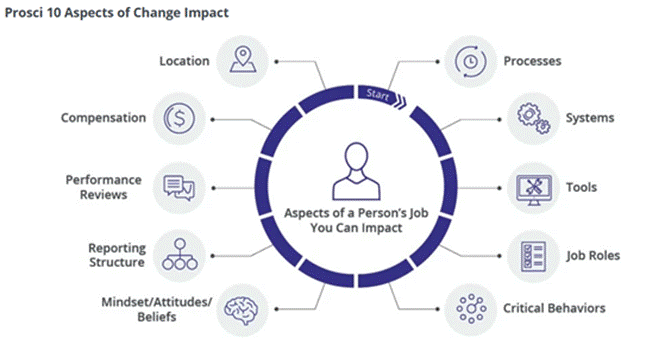
In change projects, one of the key artefacts we create are Change Impact Assessments. Creasey (2025) outlines 10 key aspects of a person’s working life that can be impacted, and this is a helpful framework for understanding the nature and scale of change for different roles.
However, it fails to account for the fact that work is far more than what we think, feel and do on a functional level. Work is powerfully connected with our self-image and identity (although hopefully not our entire identity). A change can impact not only what we need to do, but who we spend time with, who has power and influence (and who stands to lose it!) and how information and attitudes get communicated through informal networks.
Uncertainty about how a change might impact these elements is often felt on a deeply personal level. As Anderson et al (2019) explain, “humans engage in a fundamental process of “sense-making” to understand their lives. Personal uncertainty challenges this “sense-making” process and the meaning people attribute to their lives [which can] …then motivate people to manage their uncertainty… One way to manage personal uncertainty is by adhering to cultural values and norms more strongly… people become more rigid and closed-minded (McGregor et al, 2001).”
In a project context, this might explain why changes like a restructure (which may appear to be a minor change as defined according to the above change impact model) can face such fierce opposition.
To address this, we must first practice empathy to think through not just what someone might have to do differently but all the intra- and inter-personal impacts.
Once you understand the scale of these impacts, you can work on creating a new ‘story’ to help people emotionally buy into the change – show them that they matter, that they are important and their work is meaningful. We deserve to feel like our work makes a difference
Checklist
- In planning successful change, work to anticipate and minimise fear
- Fear is caused by uncertainty more than the change itself – focus on reducing uncertainty before talking about benefits
- People tend to imagine future scenarios as more likely to be negative than positive and Prospect Theory says that we assign twice as much weight to a potential loss compared to an equal gain – account for this in your Change Strategy
- Agency and self-efficacy are key ways to reduce uncertainty – empower those impacted as much as you can in designing the future state
- Include the impact on personal identity within your Change Impact Assessment – the greater the impact, the greater the chance people will cling to what they know
- Address this by directly showing how those impacted fit into the ‘story’ of the change and why they matter
The first of the FRICtion factors is Fear, which is largely tied up in how we experience uncertainty at a psychological level. Our responses are not usually logical, so it’s important we meet those going through change as fellow human beings and support them where they are (rather than where we want them to be).
This article forms part of our FRICtion Factors series.
Our whitepaper, The FRICtion Factors - what's stopping you change?, explores four factors that cause resistance, helping you to understand what’s really going on and providing practical advice on what to do about it. Click here to download the whitepaper.
BIBLIOGRAPHY
- Anderson, E. C., Carleton, R. N., Diefenbach, M. & Han, P. K. J. (2019) ‘The relationship between uncertainty and affect’, Frontiers in Psychology, 10, 2504
- Bandura, A. (1977) ‘Self-efficacy: Toward a unifying theory of behavioral change’, Psychological Review, 84(2), pp. 191-215.
- Carleton, R. N. (2016) ‘Fear of the unknown: One fear to rule them all?’, Journal of Anxiety Disorders, 41, pp. 5-21.
- Clark, T. R. (2020) The 4 stages of psychological safety: Defining the path to inclusion and innovation. 1st edn. Oakland, CA: Berrett-Koehler Publishers.
- Creasey, T. (2025) ‘Defining change impact’, Prosci.com. Available at: https://www.prosci.com/blog/defining-change-impact (Accessed: 19 September 2025).
- Dziekan, K. & Kottenhoff, K. (2007) ‘Dynamic at-stop real-time information displays for public transport: Effects on customers’, Transportation Research Part A: Policy and Practice, 41(6), pp. 489-501.
- Iyengar, S. S. & Lepper, M. R. (2000) ‘When choice is demotivating: Can one desire too much of a good thing?’, Journal of Personality and Social Psychology, 79(6), pp. 995-1006.
- Lally, P., van Jaarsveld, C.H.M., Potts, H.W.W. & Wardle, J. (2010) ‘How are habits formed: Modelling habit formation in the real world’, European Journal of Social Psychology, 40, pp. 998-1009.
- McGregor, I., Zanna, M. P., Holmes, J. G. & Spencer, S. J. (2001) ‘Compensatory conviction in the face of personal uncertainty: going to extremes and being oneself’, Journal of Personality and Social Psychology, 80, pp. 472-488.
- Rogers, E. M. (2003) Diffusion of innovations. 5th edn. New York: Free Press.
- Tversky, A. & Kahneman, D. (1973) ‘Availability: A heuristic for judging frequency and probability’, Cognitive Psychology
- Tversky, A. & Kahneman, D. (1979) ‘Prospect theory: An analysis of decision under risk’, Econometrica, 47(2), pp. 263-291.
- Zhu, Zhaobo, Qi, Zhenyan & Jin, Yi (2023) ‘Familiarity bias and economic decisions: Evidence from a survey experiment’, Economics Letters, 229.