
By Ruth Tank
Early adopters… and why we often ask the wrong things of them
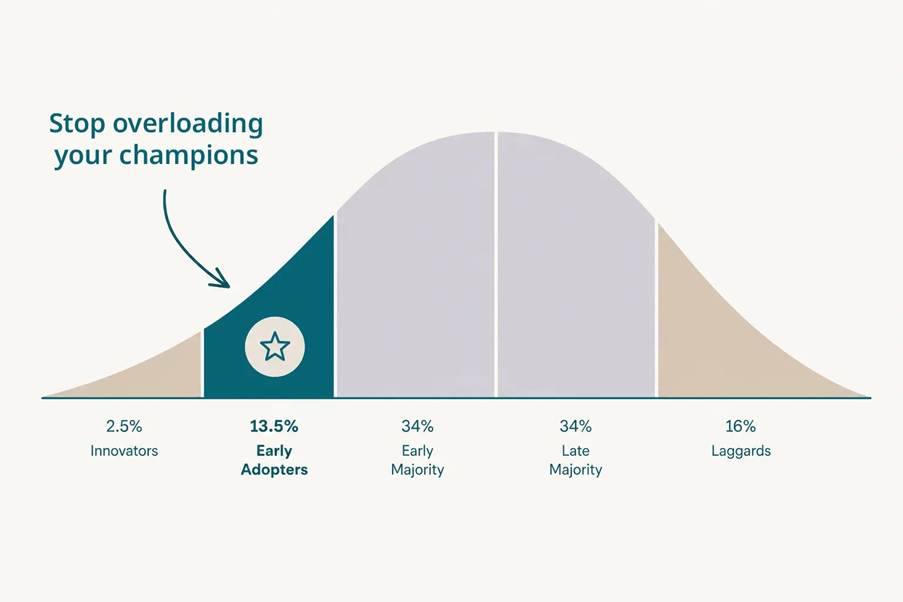
When it comes to change, people rarely respond in the same way. At one end of the responsiveness spectrum are the early adopters. These are the curious, comfortable-with-new people who’ll say “yes” to a fresh idea while others are still evaluating it.
Rogers’ Diffusion of Innovation theory (1962), later expanded by Geoffrey Moore in Crossing the Chasm, describes this natural spread elegantly. And it’s this logic that has led many organisations to create the now-standard Change Champion Network: identify your early adopters, encourage them to advocate for the programme, and hope that their enthusiasm creates a ‘pull’ for everyone else[1].
In theory, it’s tidy; but in practice it can get messy.
Three dangers of relying on early adopters as champions:
1. We expect too many skills in one person
The early adopter role in the original theory was essentially a marketing function — someone who influences peers by showing enthusiasm. But in organisations, champions are often asked to do three different jobs at once:
- Advocate and influence
- Communicate formal messages
- Act as super users or upskill others
These are distinct skillsets, and very few people genuinely hold all three.
2. We keep overloading the same people
Most organisations run multiple change programmes at any given time. The usual suspects (energetic, well-connected early adopters) can end up championing everything. So their attention, credibility and enthusiasm inevitably dilute.
3. We forget they already have day jobs
Champions still have BAU responsibilities, and that’s what they’re measured on. When time is tight, the champion role is the first thing to drop.
None of this means we should abandon champions altogether — but we should rethink how we use them.
A better way: split the role
Instead of relying on a single ‘hero’, distribute the load across different strengths:
- Advocacy - This is for well-respected senior figures. Offer them ready-made messages they can weave into BAU comms.
- Communication - For well-networked people who enjoy connecting with others. Equip them with consistent, ready-to-use collateral which they might use in their own sessions and conversations.
- Upskilling - This is for SMEs and technical experts who understand the future way of working in detail. They may not be natural presenters, but they are trusted guides and are more likely to be enthusiastic about, for instance, a new interface and how to get the most out of it.
This reduces pressure on individuals, makes better use of natural strengths, and protects people’s change capacity.
Summary
- Early adopters sit at one end of the responsiveness spectrum — and we often expect too much from them.
- Traditional “champion networks” frequently fail because the role is overloaded and misaligned with real human capability.
- Split the champion function into three roles — advocate, communicator, SME — to get the pull you want without exhausting the people you rely on.
[1] This can be explained by the Social Proof bias – where we look to others in our social group to ascertain what the ‘correct’ or ‘normal’ behaviour is
This article forms part of our FRICtion Factors series.
Our whitepaper, The FRICtion Factors - what's stopping you change?, explores four factors that cause resistance, helping you to understand what’s really going on and providing practical advice on what to do about it. Click here to download the whitepaper.
BIBLIOGRAPHY
- Blais, A. & Weber, E. U. (2006) ‘A domain-specific risk-taking (DOSPERT) scale for adult populations’, Judgment and Decision Making, 1(1), pp. 33-47.
- Kulkarni, V. (2016) ‘Employee interpretations of change: Exploring the other side of the resistance story’, Indian Journal of Industrial Relations, 52(2), pp. 246-263.
- Moore, G.A. (1991) Crossing the chasm: Marketing and selling high-tech products to mainstream customers. New York: Harper Business
- Rogers, E. (1962) Diffusion of Innovations. 1st edn. New York: Free Press of Glencoe.
- Van Dam, K., Oreg, S. & Schyns, B. (2008) ‘Daily work contexts and resistance to organisational change: The role of leader‐member exchange, development climate, and change process characteristics’, Applied Psychology, 57(2), pp. 313-334.
- Zhang, R., Thomas, J. & Andrew, W. (2014) ‘The origin of risk aversion (PNAS)’, Economics Letters