
Cognitive Load & Overwhelm
By Ruth Tank
As we look at the role of Capacity, I’m going to say something unusual for a change professional: organisations should aim to do less. Fewer change programmes. My caveat is that they execute these select programmes with greater care. This piece explains why and offers some pointers.
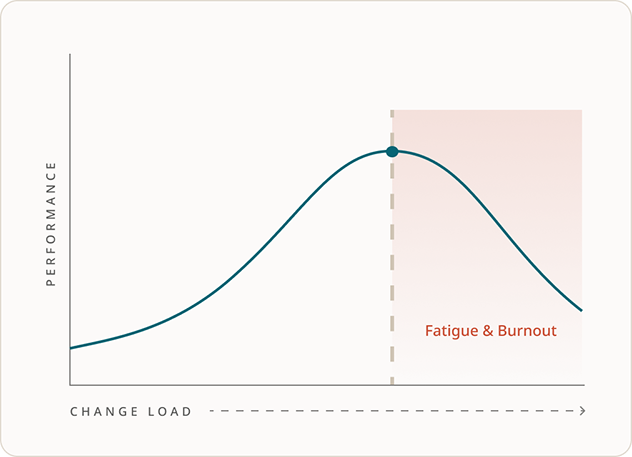
Think of our capacity for change like a river. The rate at which water flows can be equated to the amount of change we can process. Some people might naturally have a wider or deeper river than others, meaning they can cope with more change before bursting their banks, but the volume is still finite: no-one’s change capacity is limitless.
Imagine the difference between a free-flowing river and one clogged with old shopping trollies, tree branches and other debris. The volume of water that can flow through the first is much greater. When we undergo change, there are two elements that act like this debris, limiting the efficiency with which we can process new information.
Element 1: Stress hormones
When humans experience fear, the body releases glucocorticoids, the most well-known of these being cortisol. While a large dose of these can enhance memory creation, which is why we tend to remember frightening experiences clearly, it impairs both our working memory, such as processing ‘live’ information, and our ability to retrieve previously stored memories1. This has implications both for productivity during a high-stress change programme, for instance, employees’ ability to work effectively on everyday tasks and also the effectiveness of any training activities. Overall, people will find it harder to remember content they have learned.
It's therefore essential to reduce fear and increase psychological safety through honest, regular and consistent communications, as well as ensuring managers and leaders are properly equipped to lead change with empathy and appropriate people skills. Even if there is very little to say, make it clear how, what and when you will communicate.
Element 2: Working memory limitations
Deciphering new information, and encoding it to long-term memory requires conscious effort. It feels difficult – even producing physiological symptoms like heart rate variability compared with embedded knowledge and skills, which feel effortless and automatic2.
This is because our working memory capacity is limited – we can only process a few chunks of information at a time3. It is therefore important that this limited cognitive capacity isn’t wasted on extraneous content.
On change projects, those impacted are often subjected to long, convoluted emails which use jargon, ‘corporate speak’ or veiled messages that make it difficult to understand. PowerPoint presentation may look beautiful but, even with 100 slides, still fail to explain what readers actually need to do! Conversely, a presentation that has the right content but looks terrible is likely to be screened out by today’s employee, who is used to shiny content that’s optimised for engagement. A dull deck simply can’t compete with our increasingly limited attentional capacity4. Some tips that can help information land better include:
- Make communications and training materials visually attractive
- Use simple language
- Learn from new and emerging channels like social media and in-app training – the bar is so much higher than it used to be
- Use these same channels where appropriate (if you’re people love Tiktok, give them Tiktok)
- Include a clear ‘call to action’
- Above all, keep them short!
Reducing overwhelm
While we can succeed in reducing the debris from the river there's no getting away from the other element that influences whether or not it will burst its banks.
Element 3: Volume
When we consider the volume of change people are trying to cope with, it isn’t just within an organisational context. We are all undergoing multiple changes in our personal lives as well as macro-economic, geopolitical, technological and societal changes too. These are often changes we have limited control over and which add to the load. Think of these like tributaries of our imaginary river - in a downpour, each of these is pouring water into the river, increasing the flow until the river bursts its banks.
This is what we appear to be seeing in multiple spheres of modern life, leading to growing cynicism and change fatigue in the workplace5 and steadily declining mental health in the general population6.
As change leaders, we can’t control these external factors, but there is one tributary we can control – the change (or changes) going on within the organisation. Given current levels of uncertainty, cutting the amount of change may feel like wishful thinking, particularly in industries or organisations facing high levels of disruption or competitive pressures. But many companies treat change as something to be pursued for its own sake, rather than as a finite resource to be used sparingly and intentionally.
For example, one client approved a new multimedia conference suite, without considering how staff would be upskilled in how to use it. It ended up being used as a standard meeting room with none of the intended benefits realised. Gartner research shows the number of change projects organisations embark on rose from two per year in 2016 to ten in 2022, while employee support for these initiatives dropped from 74% to 38%7.
This has real consequences and the negative effects extend beyond an individual project’s chance of success. Humans are not machines and the benefits of change should be weighed against the disbenefits carefully. So that’s what’s behind my initial remark, that when it comes to change, less is more - so long as it’s done better.. That means ruthlessly prioritising the initiatives that really matter and investing in properly supporting those impacted to fully adopt and embed them.
Summary
- Chronic stress can negatively impact how we absorb and retrievenew information.Work to understand if and when that is a risk, pre-empt it in the change planning, establish ways to both avoid and address it, and continue these steps throughout the life of the project
- Working memory is limited – use that attentional capacity wisely by minimising cognitive load
- Our capacity for processing change is limited – be ruthless in prioritising your change portfolio and building in time for embedding.
This article forms part of our FRICtion Factors series.
Our white paper, The FRICtion Factors - what's stopping you change?, explores four factors that cause resistance, helping you to understand what’s really going on and providing practical advice on what to do about it. Click here to download the whitepaper.
Bibliography
- Buick, F., Blackman, D. & O’Donnell, M., O’Flynn, J. & West, D. (2015) ‘Can enhanced performance management support public sector change?’, Journal of Organizational Change Management, 28(2), pp. 271-289.
- De Souza-Talarico, J.N., Marin, M.F., Sindi, S. & Lupien, S.J. (2011) ‘Effects of stress hormones on the brain and cognition: Evidence from normal to pathological aging’, Dementia & Neuropsychologia, 5(1), pp. 8-16.
- Gartner (2023) Gartner Business Quarterly, First Quarter 2023.
- Kalyuga, S., Ayres, P., Chandler, P. & Sweller, J. (2003) ‘The expertise reversal effect’, Educational Psychologist, 38(1), pp. 23-31.
- Mind (2025) The Big Mental Health Report. Available at: mind_the-big-mental-health-report_digital4.pdf (accessed 16/02/2025)
- Paas, F.G.W.C. & van Merriënboer, J.J.G. (1994) ‘Instructional control of cognitive load in the training of complex cognitive tasks’, Educational Psychology Review, 6(4), pp. 351-371.
- Poles, A. (2025) Impact of Social Media Usage on Attention Spans. Psychology, 16, 760-772
- Stensaker, I.G. & Meyer, C.B. (2012) ‘Change experience and employee reactions: Developing capabilities for change’, Personnel Review, 41(1-2), pp. 106-124.
Footnotes