
By Ruth Tank
Why laggards may be our most valuable critics
If early adopters sit at one end of the responsiveness spectrum, the people at the other end, often labelled laggards, are usually treated as the problem. They’re seen as blockers, foot-draggers, or obstacles to progress. But that assumption is far too simple.
Even with a motivated champions network, change can feel painfully slow. Sometimes it stalls entirely. We often blame inertia, but part of the story is how change actually moves through a population. Contrary to popular belief, it’s not a smooth march toward majority acceptance. Research by Rosabeth Kanter (1977), later discussed by Malcolm Gladwell in his brilliant “Revenge of the Tipping Point”, shows that you only need about 25% of people fully on board for change to cascade. Before you hit that point, it can feel like nothing is happening.
But the harder challenge is this: What if another 25% are actively resisting?
In this tug-of-war, progress depends on understanding, not dismissing, the people holding back.
Why the term ‘laggards’ misleads us
Personally, I’ve never liked this term. Laggard is a loaded, and pejorative term which suggests that these individuals are simply behind, or against progress. But in many cases, they see themselves quite differently: as protectors of organisational memory, stewards of what works, guardians of standards and continuity.
History gives us plenty of examples of this role in its purest form. Before formal writing, communities relied on memory specialists. These arepeople whose job was to hold and transmit the knowledge that kept societies coherent and safe:
- Greek Mnemōnes
- English scops and bards
- Indian Brahmin reciters
- West African griots
- Aboriginal Songmen and Songwomen
Across cultures, these roles evolved independently. That consistency suggests something important: Groups benefit from having people who resist untested change and preserve what matters. Modern organisations need this too, especially in times of faster, noisier, and less trustworthy information.
Seen in this light, the so-called laggards are not dragging their heels: they are cultural custodians.
Why custodians matter in organisational change
Custodians often have:
- Long organisational memory
- Deep understanding of “how things really work”
- A finely tuned sense for risk
- A strong commitment to protecting what’s been proven to work
What looks like resistance is often a sophisticated stress test:
- Does this change improve things or just add noise?
- Is this the right thing, or just the newest thing?
- Have the unintended consequences been thought through?
In one study (Kulkarni, 2016), individuals labelled by HR as ‘change resistant’ insisted their actions were in the organisation’s long-term best interests.
And often, they’re right.
Change projects rarely live up to the early optimism of the planning stage. Rising costs, delays and scope changes often mean the end result is a far cry from what was hoped for at the beginning.
Seen in this light, the custodians can be seen as adding a much-needed dose of realism to the mix. The challenge is winning their trust because their bar is high.
Yet once convinced, they become invaluable: They encode new behaviours into “how we do things around here”, ensure consistency, and prevent drift once the project team has moved on.
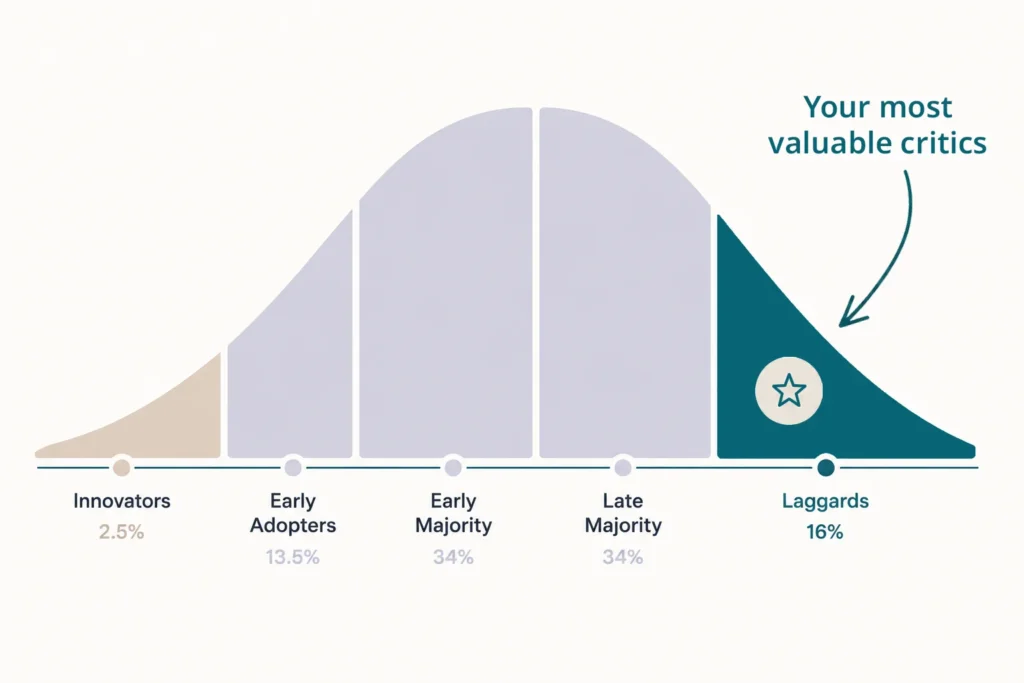
Two suggestions for working with your custodians (not against them) and getting genuine value from their perspective:
- Bring them in early as your ‘critical friends’
Invite them to tell you why the change might not work. They will surface operational insight others cannot see. Their long-tenure institutional knowledge is gold dust for anticipating obstacles. - Test honestly whether the change aligns with the existing culture
Is this truly a meaningful improvement or are you chasing a management fad? With topics like AI, for example, a first-follower approach may be wiser than rushing ahead.
Summary
- People at the ‘laggard’ end of the spectrum are often performing an important evolutionary role: protecting stability, memory and what works.
- Resistance from custodians can provide essential stress-testing of proposed change.
- Engaging them early, and respecting their insight, strengthens design, reduces risk, and increases the chance of embedding new behaviours.
This article forms part of our FRICtion Factors series.
Our whitepaper, The FRICtion Factors - what's stopping you change?, explores four factors that cause resistance, helping you to understand what’s really going on and providing practical advice on what to do about it. Click here to download the whitepaper.
BIBLIOGRAPHY
- Canevaro, M. (2020) ‘Mnemones’, in Brodersen, K., Erskine, A. & Hollander, D. (eds.) Encyclopedia of Ancient History. Wiley-Blackwell.
- Foley, J. M. (1992) The Theory of Oral Composition: History and Methodology. Bloomington: Indiana University Press.
- Gladwell, M. (2024) Revenge of the Tipping Point: Overstories, Superspreaders, and the Rise of Social Engineering. New York: Little, Brown and Company
- Hale, T. A. (1997) ‘From the Griot of Roots to the Roots of Griot: A new look at the origins of a controversial African term for bard’, Oral Tradition, 12(2), pp. 249-278.
- Kanter, R. M. (1977) ‘Some effects of proportions on group life: Skewed sex ratios and responses to token women’, American Journal of Sociology, 82(5), pp. 965-990.
- Kulkarni, V. (2016) ‘Employee interpretations of change: Exploring the other side of the resistance story’, Indian Journal of Industrial Relations, 52(2), pp. 246-263.
- Rogers, E. (1962) Diffusion of Innovations. 1st edn. New York: Free Press of Glencoe.
- Ross, M. C. (1986) ‘Australian Aboriginal oral traditions’, Oral Tradition
- Staal, F. (2009) Discovering the Vedas: Origins, Mantras, Rituals, Insights. Penguin Global.