
Habit, Effort, and Neuroplasticity
By Ruth Tank
Have you ever made a New Year’s resolution? More importantly, have you ever kept one beyond January 31st? A New Year’s resolution is the clearest example of a change that we fully embrace emotionally and intellectually. We know that the change will make our lives better, and we desperately want that future state that we imagine will transform some aspect of our lives (regardless of whether that expectation is realistic!) And yet, more often than not, our best intentions seem to fall by the wayside.
The difficulty we have in breaking bad habits and embedding better ones can be hugely frustrating and demoralising. But when you understand the neuroscience, it becomes clear that our expectations are wildly optimistic in terms of what’s realistic.
That’s because our brains rely heavily on mental shortcuts called heuristics. Heuristics are patterns of thought that help free up cognitive bandwidth – if we noticed everything around us and gave it all equal weight, the amount of information would be incapacitating (which of course is how some people experience the world).
So, our brains spot patterns, and make predictions and judgements about what’s important and what isn’t. Usually, these are fairly accurate. For example, studies show that we ‘see’ things slightly before the neural signal reaches our brain (meaning what we experience as sight is actually our brains guessing what we’re about to see (Johnson et al., 2023). But they can also lead us into automatically repeated behaviours that are familiar and habitual – even when they are not serving us well.
Studies of neuroplasticity (James, 1890; Konorski, 1948; Hebb, 1949; Bach-y-Rita et al., 1969) have shown that it is possible to break some of these patterns of thought – in fact, the brain is remarkably adaptable under the right circumstances, but that this requires a) conscious effort and b) significant reinforcement over an extended period.
I like to think of it like walking through a forest on a familiar path. Someone tells you there’s a better way of getting from A to B but it means cutting through the undergrowth. It’s possible with the right tools but it takes much more effort. Eventually, you will create a new pathway and the old one will become overgrown, but it’s energy intensive. If the old path is available and you urgently need to get from A to B, you’re likely to take the old route out of expediency, inadvertently reinforcing that path instead of the new one [1]. And if the new path represents a new business process or set of skills to be learned, then in today’s busy work context, there’s almost always pressure to get from A to B as quickly as possible.
This is important because inertia is a very different type of resistance compared with active opposition. Even if people are totally bought into the value of a change initiative, you would be well advised to support them to embed it through repetition and reinforcement in order to avoid slipping back into old habits and all that initial effort will be wasted.
Motivation
As Daniel Pink outlines in ‘Drive’ (2011), mastery of a skill can be a powerful motivator. In a change context, this presents both a problem and an opportunity.
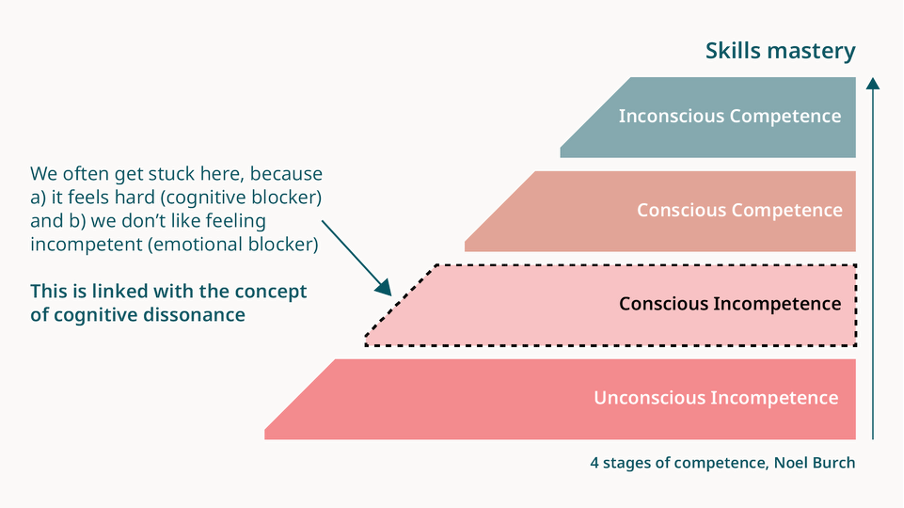
The problem is that mastery of a new skill takes time and effort, and for those who are emotionally invested in being a subject matter expert at work, it can be deeply unsettling to feel incompetent for the time it takes to learn.
Noel Burch originated the concept of the four stages of learning, where one passes from unconscious incompetence (you don’t know what you don’t know) through conscious incompetence (how most of us felt when we drove a car for the first time) to conscious competence (perhaps when performing a hobby or practising a skill) to unconscious competence (such as walking, for those who are able to do so).
Passing through these stages is hard – especially the stage from unconscious incompetence (also known as blissful ignorance!) to conscious incompetence. How many people have started a new project or tried to learn a new skill, only to give up after just a few attempts?
It’s at this point that the question becomes, “how much do you want the future state, and what are you prepared to give up in order to get it?” On change projects, leaders often woefully underestimate this basic principle – if your people have the option to continue in their current contented state, they will.
This is why it’s so important to spend time understanding the unique impacts of any change on different roles within an organisation and building tailored benefits cases to help persuade them.
The key word here is ‘unique’ – too many communications strategies talk about the benefits of the change to the business. While your people might be personally invested in the success of your organisation and/or what you deliver to your customers… I wouldn’t rely on it!
A far more effective strategy is to empathise with what people care about and the nuances that exist within and between different teams. As an added bonus, the mere act of asking people about their needs and priorities can be surprisingly powerful in generating engagement and goodwill [2].
However, if you can show how the change will enhance their existing levels of mastery, this can act as an additional motivator. With AI and digitalisation threatening so many jobs, learning how to learn (and getting comfortable with the discomfort) may be the number one skill of the future.
[1] This is why it’s so important to remove the old system or way of working wherever possible.
[2] The mechanism behind this is the principle of reciprocity: most humans are hard-wired to feel an urge to pay back an act of kindness or generosity. It’s one of the nicer human biases.
This article forms part of our FRICtion Factors series.
Our whitepaper, The FRICtion Factors - what's stopping you change?, explores four factors that cause resistance, helping you to understand what’s really going on and providing practical advice on what to do about it. Click here to download the whitepaper.
BIBLIOGRAPHY
- Bach-y-Rita, P., Collins, C. C., Saunders, F. A., White, B. & Scadden, L. (1969) ‘Vision substitution by tactile image projection’, Nature, 221, pp. 963-964.
- Burch, N. (c. 1970s) Four stages for learning any new skill. Gordon Training International
- James, W. (1890) The principles of psychology. New York: Henry Holt and Company.
- Johnson, P. A. et al. (2023) ‘Position representations of moving objects align with real-time position in human visual processing’, eLife, 12, Article e82424.
- Hebb, D. O. (1949) The organization of behavior: A neuropsychological theory. New York: Wiley.
- Konorski, J. (1948) Conditioned reflexes and neuron organization. Cambridge: Cambridge University Press.
- Pink, D. H. (2011). Drive. Edinburgh: Canongate Press.