
Rewiring the Brain
By Ruth Tank
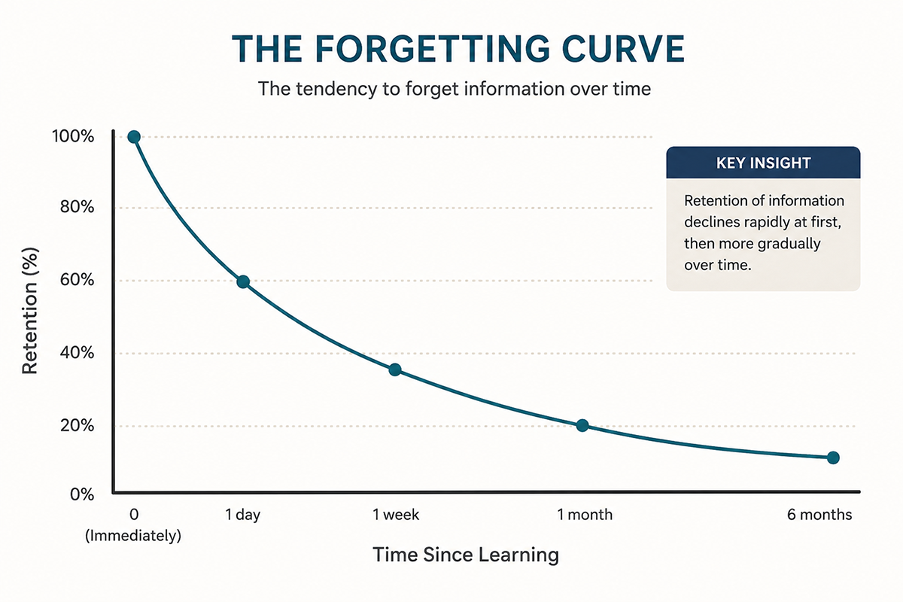
As any parent who has had to help a child with primary school maths will tell you, we forget most of what we know over time.
The Ebbinghaus Forgetting Curve (Ebbinghaus, 1913) was an early exploration of what happens when we don’t properly reinforce new learning. It shows that we forget most of what we learn within the first few days, which is why traditional classroom training is rarely effective on its own.
We might engage with the content in the moment, but the brain cannot transfer all new information into long-term memory. It needs a signal that the information is important enough to both store and retain – and that it is more important than all the other competing information our brains will receive each day.
Embedding new knowledge and skills requires:
- Selection of information to transfer from working memory to long-term memory
- Subsequent need to retrieve that information or practice that skill.
Selection
We ignore vast amounts of data each day. We couldn’t function if this weren’t the case, so how does the brain decide that something is worth retaining?
Emotions
Evidence shows that information that provokes an emotional response is more likely to be remembered (Tyng et al., 2017). Kensinger (2009) further elaborates that negative emotions have a stronger effect than positive ones. In terms of application within a change context, this explains why the Conner’s ‘burning platform’ for change is such an enduring metaphor as it focuses on the dangers of the current state (Conner, 1993).
Having said that, there are also credible studies (and lived common sense) to suggest that a constant state of moving away from danger can lead directly to stress, and its many familiar negative associations. So in a change context this isn't about being binary: combining a real sense of urgency (move away) with a vivid positive vision of the future (move toward) taps into different points on the emotion spectrum.
Storytelling
Stories are an important evolutionary mechanism by which we encode and transfer information between generations. Research (Green Brock, 2000; Isberner & Richter, 2018; Vaccaro et al., 2021) confirms that we remember information much more effectively when it is structured as a story, so this can be an especially powerful way of enhancing the stickiness of communications and training content.
Examples might be showcasing specific examples of pain points that people are experiencing with how the proposed change will make life better (and publishing success stories when it does), or explaining training content using specific real-life use cases rather than generic examples. It can also be helpful to consider the change as a ‘hero’s journey’, making those impacted the protagonists, change practitioners as the guide, and the current way of working as the ‘villain’ that must be overcome to achieve the desired future state.
Retrieval or practice
As the saying goes, “use it or lose it!”. The more often we retrieve information, the more embedded those neural pathways become. We can support this process during change projects by finding ways to include retrieval within our training strategy. This starts right from the first training intervention: short quizzes interspersed within chunks of training content can significantly improve retention, even months later (Roediger & Karpicke, 2006), so building in appropriate, low stakes tests are more effective that simply consuming the training content alone.
But given how plastic the brain is – constantly optimising its storage capacity to align with the current needs of the environment and filtering out so much – we cannot expect knowledge that is important at a particular point in time to be retained indefinitely. This concept that learning must be reinforced is not news, but precisely how to apply this in practice may be less so.
Cepeda et al. (2008) have studied the optimal period between learning events and found that there is wide variation in knowledge retention depending on this ‘spacing effect’. Test subjects were given two training sessions spaced between zero days and three months apart. They were then tested on how much they remembered from seven days up to a year later.
The differences in retention were dramatic – a 64% difference between the worst and best gaps. The results were non-linear, but the most relevant finding for our purposes was that:
- If people need to remember information a week after training, they should have (at least) two training events spaced a day or two apart (but no closer).
- If they will not need to remember that information a month after training, then a gap of seven to ten days is ideal.
- If you don’t have this flexibility, increasing the gap between training sessions is less damaging than decreasing it – shorter gaps had a much more dramatic negative effect than longer ones (Cepeda et. Al, 2008).
So, how much time does it take for a new skill to become a habit? As you’d expect, this very much depends on many factors, such as complexity of task, individual motivation and level of proficiency required, but Lally et al (2010) showed that with daily practice, new behaviours became automatic at around two months (66 days). A meta-analysis conducted by Singh et al (2024) backed up this figure of roughly two months for habit formation. This has a couple of implications for change programmes:
- Ensure that training support continues for at least two months after the ‘go live’ of any new changes (if they need to use the knowledge regularly).
- It could be worthwhile communicating this statistic to those impacted, both to manage expectations and to reinforce the importance of daily practice [1].
- Gamify engagement with the learning content - offer rewards, recognition or publish a leaderboard to encourage regular (ideally daily) practice.
[1] The variation was large, however – ranging from 18 to 254 days (Lally et al, 2010).
Practical example
One client I worked with had a very decentralised workforce of around 40,000, spread across multiple depots and regional offices. Many were frontline workers, with an average reading age of 10, and there was a huge variation in levels of digital skills and confidence. We did a series of roadshows with in-person presentations and a team of floor walkers with iPads to show people what to do in real time. We then did train-the-trainer sessions, equipping them to run follow up sessions. For those who were office based, we provided a ‘single-source-of-truth’ intranet page with all the training collateral: guides, videos, top tips.
This article forms part of our FRICtion Factors series.
Our whitepaper, The FRICtion Factors - what's stopping you change?, explores four factors that cause resistance, helping you to understand what’s really going on and providing practical advice on what to do about it. Click here to download the whitepaper.
BIBLIOGRAPHY
- Cepeda, N. J., Pashler, H., Vul, E., Wixted, J. T. & Rohrer, D. (2008) ‘Spacing effects in learning: A temporal ridgeline of optimal retention’, Psychological Science, 19(11), pp. 1095-1102.
- Conner, D. R. (1993) Managing at the speed of change: How resilient managers succeed and prosper where others fail. New York: John Wiley & Sons.
- Ebbinghaus, H. (1913) Memory: A contribution to experimental psychology (H. A. Ruger & C. E. Bussenius, Trans.). New York: Teachers College, Columbia University.
- Green, M. C. & Brock, T. C. (2000) ‘The role of transportation in the persuasiveness of public narratives’, Journal of Personality and Social Psychology, 79(5), pp. 701-721
- Isberner, M.-B., Richter, T., Schreiner, C., Eisenbach, Y., Sommer, C. & Appel, M. (2018) ‘Empowering stories: Transportation into narratives with strong protagonists increases self-related control beliefs’, Discourse Processes, 56(8), pp. 575-598.
- Kalyuga, S., Ayres, P., Chandler, P. & Sweller, J. (2003) ‘The expertise reversal effect’, Educational Psychologist, 38(1), pp. 23-31.
- Kensinger, E. A. (2009) ‘Remembering the details: Effects of emotion’, Emotion Review, 1(2), pp. 99-113.
- Lally, P., van Jaarsveld, C. H. M., Potts, H. W. W. & Wardle, J. (2010) ‘How are habits formed: Modelling habit formation in the real world’, European Journal of Social Psychology, 40(6), pp. 998-1009.
- Murre, J. M. J. & Dros, J. (2015) ‘Replication and analysis of Ebbinghaus’ forgetting curve’, PLOS ONE, 10(7), e0120644.
- Roediger, H. L. III & Karpicke, J. D. (2006) ‘The power of testing memory: Implications for educational practice’, Perspectives on Psychological Science, 1(3), pp. 181-210.
- Rogers, E. (1962) Diffusion of Innovations. 1st edn. New York: Free Press of Glencoe.
- Staal, F. (2009) Discovering the Vedas: Origins, Mantras, Rituals, Insights. London: Penguin Global.
- Tyng, C. M., Amin, H. U., Saad, M. N. M. & Malik, A. S. (2017) ‘The influences of emotion on learning and memory’, Frontiers in Psychology, 8, Article 1454.
- Vaccaro, A. G. et al. (2021) ‘Functional brain connectivity during narrative processing relates to transportation and story influence’, Frontiers in Human Neuroscience, 15, Article 665319.
- Zhang, R., Brennan, T. J. & Lo, A. W. (2014) ‘The origin of risk aversion’, Proceedings of the National Academy of Sciences of the United States of America, 111(50), pp. 17777-17782.