
Reducing Cognitive Load
By Ruth Tank
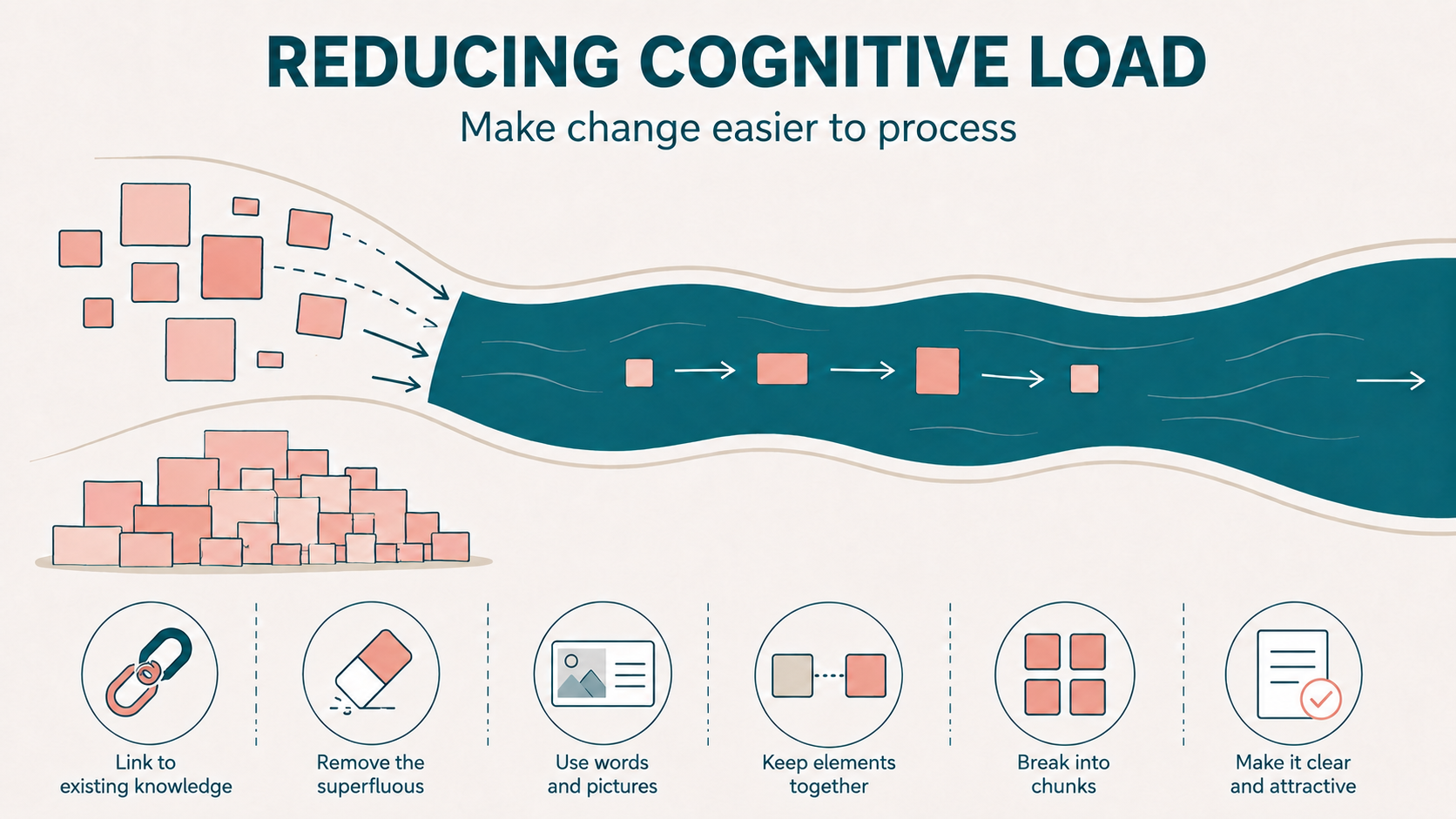
In Part One of this blog, we explored the analogy of a river to represent our finite capacity to process change. The rate at which water flows through the river can be equated to the amount of change we can comfortably take on. Some people might naturally have a wider or deeper river than others, meaning they can cope with more change before bursting their banks, but the volume is still finite: no-one’s change capacity is limitless.
This rate of flow can be equated with the concept of cognitive load. Our working memory capacity is limited – only a few chunks of information can be processed at any one time1. But there are some ways we can improve our ability to process this information, and these are outlined below.
Link with existing knowledge
Change is easier to embed if it can be related to what we already know. This is known as elaborative encoding – the process by which we link new information with existing schema in the brain2. So, for example, when we drive a different model of car, we don’t have to learn to drive from scratch. A professional musician can learn a new piece of music quickly because they’ve long since embedded the ability to read music and play each note.
On change programmes, if we can link new systems or processes to ones people are familiar with, it will be far easier for them to embed in their existing knowledge and habitual ways of working. This could mean giving examples based on existing processes, or using case studies, pilot examples or illustrations from other organisations within a relatable to their industry or function.
Remove the superfluous
Linked with the above, it’s important to remember that while the professional musician is only focused on what’s new, ie, the specific piece of music rather than where middle ‘C’ is on the keyboard, part of being a novice learner is that they cannot distinguish between relevant vs irrelevant information3. If you drive, do you remember how completely overwhelming it was the first time you did it? But once you are proficient, stepping into a new car means you only focus on whether the controls are different. You hopefully no longer need to worry about ‘mirror, signal, manoeuvre’ or the rules of roundabouts.
This is why, when you introduce new ways of working, it’s so important to keep as much as possible the same, and make this explicit in your communications and training activity. Use existing brand identity guidelines, keep key words and phrases consistent, use learning channels users are familiar with, or customise the system interface to look as similar as possible to the previous system. It certainly means that any screenshots included in training materials should be identical to what users see when they log into a system, or users will be distracted trying to figure out why some things are different rather than focusing attentional capacity on the task4.
Multimedia learning
We use different parts of the brain to decipher words vs pictures, each of which has its own capacity5. By using media in combination, eg by including diagrams as well as words in slide decks or creating a video animation with spoken word voiceover, we significantly increase the amount of cognitive capacity available to absorb and retain the information being communicated as well as supporting the process of embedding knowledge.
In fact, 100% of 11 comparison tests showed that “learners who received words and pictures performed better on transfer tests than did students who received words alone”6.
Link elements spatially and temporally
While multimedia learning can reduce cognitive load, the elements must be presented close to each other - either spacially, if it’s static content, or in time if it’s audio-visual content. You need to show what belongs together. Otherwise, the audience will waste cognitive capacity having to piece the elements together, sometimes called the ‘split-attention effect’7.
This may seem obvious. In a training guide, why wouldn’t you put the appropriate screenshot next to step-by-step instructions. However, consider the (temporal) space between someone having to use new software and that person getting their hands on the right user guide.You’d be surprised how often comms and training content is shared at a time that suits the project team, rather than on-demand. People reliably take in information more effectively at the point when it’s most relevant to them..
There are many ways of providing this ‘self-service’ support – for example:
- Provide a dedicated space, maybe a SharePoint site or similar, where all materials related to the change are stored.
- Create closed (super) user communities – so people have point-of-need access to peer support
- Build a bot or AI agent so they can access just the information they specifically need or get recommendations for further reading, eg,'you may also like...'
- Offer an audio/narrated version of the key learnings.
- Produce a bitesize podcast series with follow-up notes.
These are just some of the ways we can enable those impacted to immerse themselves in the topic at a time that suits them, rather than having work-related cognitive processes interrupted by change-related communications or training. Even better, having key message and instructional content embedded within a new system avoids users having to waste cognitive load finding and referring to external content. Many in-app solutions now offer this type of upskilling capability, such as WalkMe.
Break down learning into chunks
You can think of this either in hierarchical or modular terms. It depends whether the aim is to get on top of a whole set of skills, such as being the admin user for a business critical application); or to be able to complete discrete tasks effectively, for example a functional expert, who only needs to complete specific parts of an overall process. Either way, learning, practising and embedding smaller packages of information is easier than tackling large bodies of content8.
This is where traditional training approaches can fall down, although the practicalities of modern work mean it’s usually the only way to carve out sufficient time in employees’ diaries to dedicate to learning.
This is effective in the classroom too - break down learning into smaller chunks and make sure they’re fully practised and reinforced before moving onto the next training item. Supplement the approach with Quick Reference Guides,, ‘lunch-and-learn’ sessions or top tips to reinforce learning after the training session. Paas, see below, presents some specific recommendations for structuring these learning chunks.
- Start with a high-level, low detail overview of the whole task or process; have limited practice activities at this stage or keep them abstract rather than specific
- Next tackle a sub-component of the whole process in more detail; practice activities should be highly constrained this means plenty of guidance and step-by-step support at each stage
- Move to more detailed and specific sub-components of the tasks; practice activities should become increasingly loose, with less guidance and support as learners build confidence.
Aesthetics
While I’d love to think the brilliance of my work speaks for itself, it’s really the designers who have the power to make or break most communications content. It’s a sad fact that tall men are seen as more competent than short ones9, and attractive people are judged as more honest and intelligent10 – this is called the ‘halo effect’ and it means that if your work is not attractive, the content will be seen as of lower value.
While the definition of ‘beautiful’ is constantly evolving, and will vary between corporate and individual beholders, there is evidence that the lower the cognitive load of a piece of content, the more likely it is to be judged as beautiful11. Okuhara et al (referenced below) present these proven recommendations for reducing cognitive load:
- Use a clear font on a high-contrast background
- Use language which is lexically and semantically easy to parse: ie, keep it simple
- Use round numbers, eg, “about 100” rather than “103”
- Limit the number of key points within a communication or learning ‘chunk’ to no more than five – readers won’t remember more than that
- Help your audience imagine themselves in a positive but plausible future – the more realistic the mental image, the easier it is to remember
Investing in specialist communications support and creative design could make the difference between your message being heard and understood, or screened out.
If you’ve ever nearly thrown a tantrum because you said something 10 times and people still told you they “didn’t know”…this could well be why.
Finally, a word of warning for those who still think it’s ‘just’ communications. Consider the last time you got a new gadget from a well-known brand: the quick-start guide was likely no more than a few short, well-designed pages. Indeed, the chances are that the user experience was so intuitive you didn’t need to consult that sleek little guide at all! So when people do need instructions, let’s make them easy on the eye and a joy to consume.
Checklist
Techniques that can reduce the cognitive load associated with deciphering new information whether in communications or training materials, include:
- Link with existing knowledge
- Remove the superfluous
- Multimedia learning
- Link elements spatially and temporally
- Break down learning into chunks
- Aesthetics
This article forms part of our FRICtion Factors series.
Our whitepaper, The FRICtion Factors® - what's stopping you change?, explores four factors that cause resistance, helping you to understand what’s really going on and providing practical advice on what to do about it. Click here to download the whitepaper.
BIBLIOGRAPHY
- Okuhara, T., Ishikawa, H., Okada, M., Kato, M. & Kiuchi, T. (2017) ‘Designing persuasive health materials using processing fluency: A systematic review’, BMC Public Health, 17(1), Article 198.
- Alter, A.L. & Oppenheimer, D.M. (2009) ‘Unite the tribes of fluency: Response to commentary and review’
- Dion, K., Berscheid, E. & Walster, E. (1972) ‘What is beautiful is good’, Journal of Personality and Social Psychology, 24(3), pp. 285-290.
- Judge, T. A. & Cable, D. M. (2004). The effect of physical height on workplace success and income: Preliminary test of a theoretical model. Journal of Applied Psychology, 89(3), 428–441
- Kalyuga, S., Ayres, P., Chandler, P. & Sweller, J. (2003) ‘The expertise reversal effect’, Educational Psychologist, 38(1), pp. 23-31.
- Karpicke, J.D. & Blunt, J.R. (2011) ‘Retrieval practice produces more learning than elaborative studying with concept mapping’, Science, 331(6018), pp. 772-775.
- Mayer, R.E. (2001) Multimedia Learning. Cambridge: Cambridge University Press.
- Mayer, R.E. & Moreno, R. (2003) ‘Nine ways to reduce cognitive load in multimedia learning’, Educational Psychologist, 38(1), pp. 43-52.
- Paas, F.G.W.C. & van Merriënboer, J.J.G. (1994) ‘Instructional control of cognitive load in the training of complex cognitive tasks’, Educational Psychology Review, 6(4), pp. 351-371.
- Sweller, J. (1988) ‘Cognitive load during problem solving: Effects on learning’, Cognitive Science, 12(2), pp. 257-285.
Footnotes
- Kalyuga et al., 2003 ↩︎
- Ibid. ↩︎
- Paas & van Merriënboer, 1994 ↩︎
- This is a real challenge with evergreen cloud technologies, which are constantly evolving, meaning training content is out of date almost as soon as it’s created. But this also illustrates the point: if you search YouTube for an instructional video on how to use a Microsoft application you have never used before, for example, it will be very difficult to find something you can trust to be accurate and up to date. But once you are familiar with that application, it might be irritating when a button moves or a new feature is released, but you quickly assimilate that new knowledge into your existing schema for that tool. ↩︎
- Mayer, 2001 ↩︎
- Mayer, 2001. Note that adding subtitles as well as narration to a video was shown to overwhelm the visual mode and result in poorer learning outcomes. However, from an inclusion perspective it’s essential to cater to diverse needs, so we’d always recommend including subtitles for any spoken-word medium. ↩︎
- Kalyuga et al., 2003 ↩︎
- Paas van Merriënboer,1994 ↩︎
- Judge & Cable, 2004 ↩︎
- Dion et al., 1972 ↩︎
- Okuhara et al., 2017; Alter & Oppenheimer, 2009 ↩︎